Insect pests of potato

|

|
Crop: Potato
S.N: Solanum tuberosum
Family: Solanacae
Pests |
Important pests of Potato
1. Greasy Cutworm/ Black cut worm: Agrotis ipsilon,
Symptoms of damage
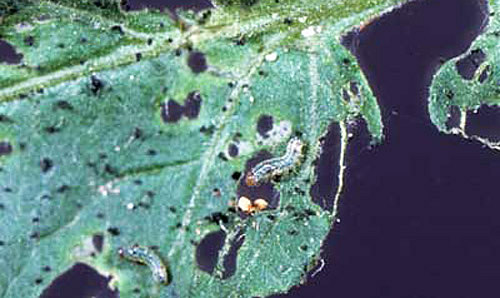
- Young larvae feed on the epidermis of the leaves.
- Older larvae come out at night and feed young plants by cutting their stems
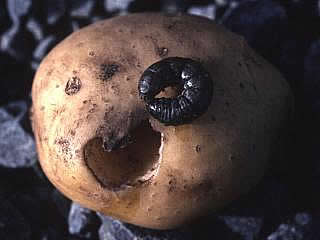
- They also damage the tubers by eating away part of them.
Identification of the pest
Eggs
- Creamy white, dome-shaped eggs, laid singly on lower surface of the leaves
Larvae
- Newly emerged young larva is yellow in colour
- The full-grown larva is dark or dark brown with a plump and greasy body.
 |
 |
Pupa
- Dark brown pupae are found in earthen cells lying underground in the potato fields.
Adult Moth
- Dark with some grayish patches on the back and dark streaks on the forewings.
|
Larva |
Adult |
Management
- Flood the infested fields.
- Hand –pick and destroy the larvae – morning and evening hours on cracks and crevices in the field
- Plough the soil during summer months to expose larvae and pupae to avian predators
- Set up light trap @ 1/ ha
- Pheromone traps @ 12/ ha to attract male moths
- Spray insecticides like chlorpyriphos 20EC @ 1 lit/ha or neem oil @ 3%
Top
2. Potato tuber moth: Phthorimaea operculella
Symptoms of damage
- Egg - laid singly –the ventral surface of foliage and exposed tubers.
- Larva - Yellow coloured caterpillar with dark brown head.
- Pupa: Pupation occurs within a cocoon among the trash, clods of the earth in the field.
- Adult: Small narrow winged moth, greyish brown forewings and hind wings- dirty white.
 |
 |
Larvae |
Adult |
Management
-
Select healthy tubers
-
Avoid shallow planting of tubers. Plant the tubers to a depth at 10 - 15 cm deep.
-
Install pheromone traps at 15/ha.
-
Collect and destroy all the infested tubers from the field
-
Do not leave the harvested tubers in the field overnight
-
Adopt intercropping with chillies, onion or peas
-
Do earthing up at 60 days after planting to avoid female moths laying eggs on the exposed tubers
-
Cover the upper surface of potato tubers with the branches of Lantana and Eupatorium to repel the ovipositing moth in the godown
-
Release egg larval parasitoid: Chelonus blackburnii @ 30,000/ha twice – 40 and 70 day after planting
-
Spray NSKE @ 5% or quinalphos 25 EC @ 2ml/lit of water to manage foliar damage
-
Spray Bacillus thuringiensis @ 1 kg /ha at 10 days interval
Top
3. White grubs: Holotrichia sp.
Symptoms of damage
- Grubs feed on roots and tubers
Identification of the pest
Larva:
‘C’ shaped grub
Adult
Brown beetle with pale prothorax
Management
- Summer ploughing to expose pupae
- Quinalphos 5% Dust @ 25 kg/ ha – 10 days after first summer rain
- Set up light trap @ 1/ha between 7 PM and 9 PM
- Hand – pick adult beetles in the morning.
Top
4. Tobacco Caterpllar: Spodoptera litura
Symptoms of damage
- The young larvae first feed gregariously and scrape the leaves.
- Older larvae spread out and may completely devour the leaves resulting in poor growth of plants.
Top
Identification of the pest
-
Egg: -masses appear golden brown
-
Larva: - pale greenish with dark markings
-
Gregarious in the early stages
 |
 |
Adult
- Forewings – brown colour with wavy white marking
- Hind wings- white colour with a brown patch along the margin
|
Larva |
Adult |
Top
Management
- Plough the soil to expose and kill the pupae
- Grow castor along border and irrigation channel as trap crop
- Flood the field to drive out the hibernating larvae
- Set up light trap @1/ha
- Pheromone traps (Pherodin SL) @ 15/ ha to attract male moths
- Collect and destroy egg masses in castor and tomato
- Hand pick grown up larvae and kill them
- Spray Sl NPV @ 1.5 X 10¹² POBs / ha + 2.5 Kg crude sugar + 0.1 % teepol
Poison bait
-
Rice bran 5 Kg + Molasses or Brown sugar 500g + Carbaryl 50 WP 500g+ 3lit of water/ha
-
Mix the ingredients well – Kept around the field in the evening hours
-
Spray chlorpyriphos 20 EC 2lit/ha or dichlorovos 76 WSC 1 lit/ha
Top
5. Green Leaf Hopper Empoasca kerri
Symptoms of damage
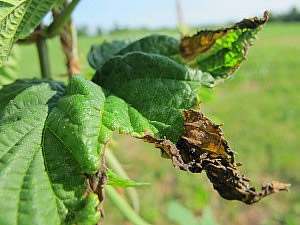
- Tips of affected leaves become brown, turn upwards and get dried up
Top
 |
Identification of the pest
- Egg - elongated yellow-white egg is deposited in leaf vein.
- Nymph - Pale – green, wedge shaped
- Winged pads extend up to the fifth abdominal segment.
Adult
|
Management
6. Green peach aphid: Myzus persicae
Symptoms of damage
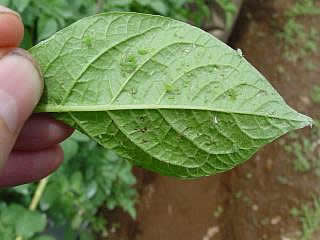
- Aphids suck sap of plants, as a result of which leaves turn pale and dry up.
- This pest also transmits various viral to potato plants.
Identification of the pest
Nymph
Management
7. Whitefly: Bemisia tabaci
Symptoms of damage
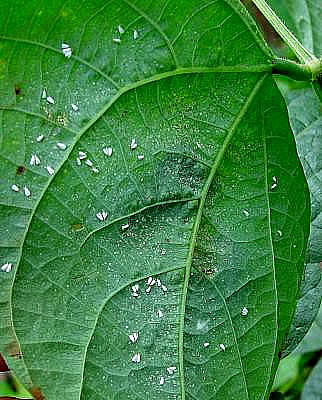
- Nymphs suck sap from the leaves and lower their vitality.
- Yellowing and curling of leaf
- Sooty mould develops on affected leaves
Top
Identification of the pest
Egg
-
It is smooth, sub elliptical, stalked at broader basal end.
-
Its colour is light yellow, when freshly laid, turn dark brown later on.
Nymph
Adult
Top
Management
|