TNAU Agritech Portal
  Home | About Us | Success Stories | Farmers Association | Farmers' Innovation | TNAU Publications | FAQs | Contact

Crop Protection :: Pests of Brinjal

Insect pests of Brinjal


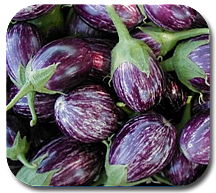
Common name:Brinjal

S.N: Solanum melongena

Family: Solanaceae

Pests

Important pests of Brinjal

Shoot and fruit borer: Leucinodes orbonalis
Stem borer: Euzophera perticella
Bud worm: Scrobipalpa blapsigona
Hadda / spotted beetle: H.vigintioito punctata
Ash weevils: Myllocerus subfasciatus, M. discolor, M. viridanus
Brown leaf hopper: Cestius phycitis
Lace wing bug: Urentius hystricellus

1. Shoot and fruit borer: Leucinodes orbonalis      

p45D

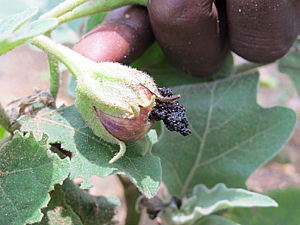
Symptoms of damage

  • Withering of terminal shoots/ dead hearts
  • Bore holes on shoots  and fruits plugged with excreta
  • Shedding of flower buds
  • Withering and drying of leaves
Withering
Bore hole

Top

Identification of the pest
  • Eggs  -  Creamy white eggs
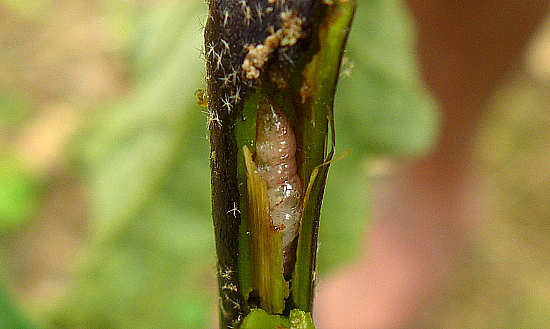
  • Larva -  pink in colour
  • Pupa- greyish boat shaped cocoon
  • Adult-   a medium  sized moth
  • Forewings- having black and brown patches and dots on white colour
  • Hind wings – opalescent with black dots
Larva
Pupa
Adult

Top

Management

  • Remove the affected terminal shoot showing boreholes.
  • Remove the affected fruits and destroy.
  • Avoid continuous cropping of brinjal crop
  • Grow the varieties with long and narrow fruits in endemic areas
  • Install pheromone trap@12/ha
  • Encourage the activity of larval parasitoids:
      • Pristomerus testaceus
      • Cremastus flavoorbitalis
  • Avoid use of synthetic pyrethroids
  • Avoid using insecticides at the time of fruit maturation and harvest
  • Neem seed kernel extract (NSKE) 5 % or any one of the following chemicals starting from one month after planting at 15 days interval

Insecticide

Dose

Azadirachtin 1.0% EC (10000 ppm)

3.0  ml/lit.

Azadirachtin 0.03 % WSP (300 ppm)

5.0  g/lit.

Chlorpyrifos 20 % EC

1.0  ml/lit.

Dimethoate 30 % EC

7.0  ml/10 lit.

Emamectin benzoate 5 % SG

4 g/10 lit.

Flubendiamide 20 WDG

7.5 g/10 lit.

Phosalone 35 % EC

1.5  ml/lit.

Quinalphos 25 % EC

1.5 ml/lit.

Thiodicarb 75 % WP

2.0 g/lit.

Thiometon 25 % EC

1.0 ml/lit.

Trichlorofon 50 % EC

1.0 ml/lit.

Triazophos 40 % EC

2.5 ml/lit.

Top

2. Stem borer: Euzophera perticella 
Symptoms of damage

  • Top shoots of young plants droop and wither.
  • Older plants become stunted.
  • Fruit bearing is affected

Top


Identification of the pest

  • Egg- Cream, scale-like
  • Larva - Fully grown larva is creamy white
  • Adult - Greyish brown,
  • Forewings- with transverse line and
  • Hind wings - white in colour

Top 

Management

  • Collect and destroy the damaged and dead plants
  • Light trap @ 1/ha to attract and kill adults
  • Spray neem oil 2ml/lit  
  • Avoid using synthetic pyrethriods causing resurgence

Top

3. Bud worm: Scrobipalpa blapsigona 
Symptoms of damage

  • Shriveling and shedding of flower buds

Top

258-1741_Scrobipalpa_obsoletella_m

Identification of the pest

  • Larvae - pale whitish  with pink tinge
  • Adult - small with fringed wings.

Management

  • Spray neem oil 2ml/lit

  Top

4. Hadda / spotted beetle: H.vigintiocto punctata 
Symptoms of damage

  • Scrapping of chlorophyll
  • Skeletonization and drying of leaves
Skeletonization - Grub damage Skeletonization - Adult damage

Top

Identification of the pest

  • Eggs- Cigar shaped, yellow in colour
  • Grub:  Yellowish bearing six rows of longitudinal spines.
  • Pupa: Yellowish with spines on posterior part and anterior portion being devoid of spines.
untitled

Adult

  • H. vigintioctopunctata : 14 spots on each elytra, deep red.

Top

Management

  • Collect damaged leaves with grubs and egg masses and destroy them
  •   Shake plants to dislodge grubs, pupae and adults and destroy
  •   Conserve natural enemies in brinjal ecosystem
  •  Spray any one of the insecticides
    • Carbaryl 50 WP @ 3g/lit

Top

5. Ash weevils: Myllocerus subfasciatusM. discolorM. viridanus,
M. maculosus

Symptoms of damage

  • Notching of leaf margins
  • Grubs feed on roots - wilting of plants
V - shape notching 

Identification of the pest

  • Larva: grub - small and apodous
  • Pupa: Pupates in soil in earthern cocoons
DH7HAHIHOHIHOHKLDHIH6ZZLWZUHAZMLLR8HLRMLLR9HRR9HYHMHCH4H4Z8HDHIH8Z8H5Z8HVH

Adult

  • M. maculosus: greenish white with dark lines on elytra
  • M. subfasciatus: Brown
  • M. discolor: Brown and white spots
  • M. viridanus: Small light green weevil

Management

  • Collect and destroy adults
  •  Apply Neem cake @ 500 kg / ha at the time of last ploughing
  •   In endemic areas, apply carbofuran 3 G @ 15 kg/ ha – 15 days after planting
  •   Spray carbaryl 50 WP @ 3g + wettable sulphur 50 WP @ 2g/lit  

Top

6. Brown leaf hopper: Cestius phycitis 
Symptoms of damage

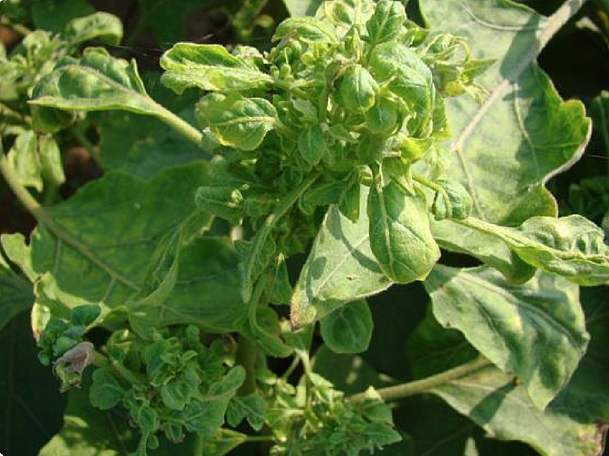
  • Reduction in size of leaves
  • Shortened petioles,
  • Excessive growth of branches general stunting of plants,
  • Conversion of floral parts into leafy structures and
  • Plants become bushy
  • Fruiting is rare.
  • Vector of little leaf of brinjal

Top

Identification of the pest

  • Small light brown leaf hopper

Management

  • Rogue out infected plants destroy them.
  • Before transplantation dip the seedlings in 0.2% carbofuran 50 STD solution(control insect vectors).
  • Spray with methyl parathion 0.5% or dimethoate 0.3%.

Top


7. Lace wing bugUrentius hystricellus

Symptoms of damage

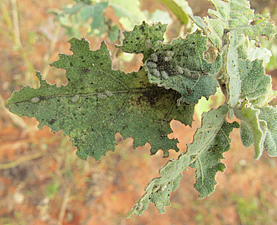
  • Yellowing of leaves
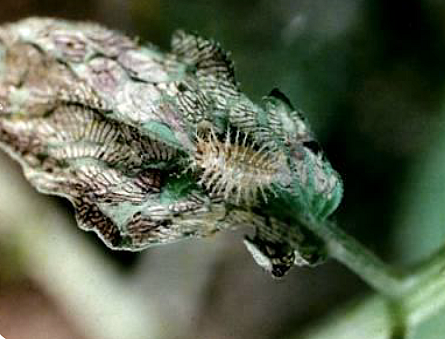
  • Affected leaves covered with  exuviae and excreta
Affected leaves covered withexcreta
Yellowing

Top

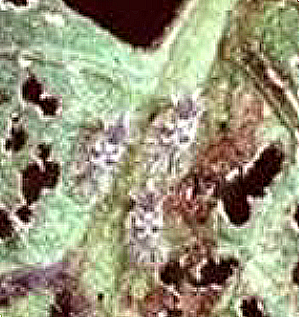
Identification of the pest

  • Egg -white nibble shaped eggs
  • Nymph – yellowish white with prominent spines

Adult

  • Dorsal side - straw coloured
  • Ventral side – black coloured
  • Pronotum and forewings reticulated

Management

  • Spray dimethoate 30 EC @ 1 lit / ha or  methyl demeton 25 EC @ 1lit /ha

Top

Source

padvalagriculture.blogspot.com

www.ikisan.com


Home | About Us | Success Stories | Farmers Association | TNAU Publications | FAQs | Site Map | Disclaimer | Contact Us

© 2013 TNAU. All Rights Reserved.