Crop Protection :: Pest of Sorghum
I. Borer
| 1. Shootfly: Atherigona varia soccata |
Symptom of damage
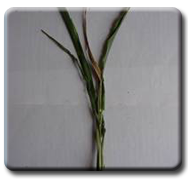
- The maggot bores inside the stem and cuts the growing point.
- Central shoots dried and produce “dead heart” symptom.
- The infested plant produces side tillers.
|
Identification of the pest
- Egg - white, cylindrical, distal somewhat flattened
- Adult - Whitish grey fly
|
|
Management
- ETL: 1 egg/plant in 10% of plants in the first two weeks of sowing or 10% dead
hearts
- Take up early sowing of sorghum immediately after the receipt of
South West or North East monsoon to minimise the shoot fly
incidence.
- Use seeds pelleted with insecticides
- Seed treatment with imidacloprid 70 WS @ 10 g/kg of seeds
- In case of direct seeding, use increased seed rate upto 12.5
kg/per hectare and remove the shoot fly damaged seedlings at
the time of thinning or raise nursery and transplant only healthy
seedlings.
- Plough soon after harvest, remove and destroy the stubbles.
- Set up the TNAU low cost fish meal trap @ 12/ha till the crop is
30 days old.
|
Spray one of the following for an area of 120 m2 nursery :
- Methyl demeton 25 EC 12 ml/ha
- Dimethoate 30 EC 12 ml/ha
In main field for direct sown crop spray any one of the following
- Methyl demeton 25 EC 500 ml/ha
- Dimethoate 30 EC 500 ml/ha
- Neem Seed Kernel extract 5%
- Soil application of phorate 10 G 18 kg/ha or carbofuran @ 33.3
kg /ha at the time of sowing
|
Top
|
| 2. Stem borer, Chilo partellus |
Symptoms of damage
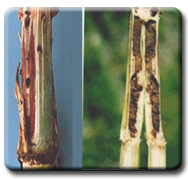
- Withering and drying of central shoot -“dead heart”
- Red mining in the midrib
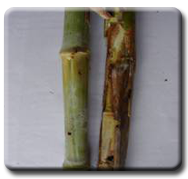
- Bore holes visible on the stem near the nodes.
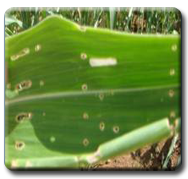
- Tender folded leaves have parallel “shot hole”
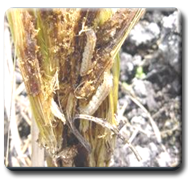
- Affected parts of stem may show internally tunneling of caterpillars
Identification of the pest
- Egg - Scale-like flat oval eggs in batches on the under surface of leaves near the midribs.
- Larva - Yellowish brown with a brown head and prothoracic shield.
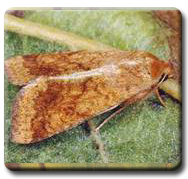
- Adult - Moth is medium size, straw coloured.
|
Management
- ETL: 10% damage
- Sowing the lab lab / cowpea as an intercrop to minimise
stemborer damage (Sorghum: Lab lab /cowpea 4:1).
- Set up of light traps till mid night to monitor, attract and kill adults
of stem borer, grain midge and earhead caterpillars
- Mix any one of the following insecticides with sand to make
up a total quantity of 50 kg/ha and apply in the leaf whorls :
- Phorate 10 G 8 kg/ha
- Carbofuran 3 G 17 kg/ha
- Spray any one of the following insecticides :
Carbaryl 50 WP 1.00 kg/ha (500 l spray fluid/ ha).
|
| |
Top
|
| 3. Pink stem borer: Sesamia inferens |
Symptoms of damage
- Central shoots dried and produce the dead hearts.
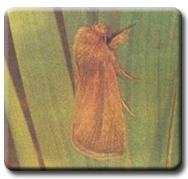
Identification of the pest
- Egg - Bead like laid in rows within the leaf sheath
- Larva - Pinkish brown with dark head
- Adult - Straw coloured moth with white wing
|
 |
|
II. Earhead feeders
| 4. Ear Head caterpillar: Helicoverpa armigera |
Symptoms of damage
- Earheads are partially eaten with chalky appearance.
- Feacal pellets are visible within the ear heads.
|
Identification of the pest
- Eggs - Spherical in shape and creamy white in colour, laid singly
- Larva - Shows colour variation from greenish to brown.
- It has dark brown grey lines on the body with lateral white lines
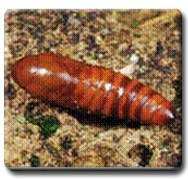
- Pupa - Brown in colour, occurs in soil, leaf, pod and crop debri
Adult
- Light pale brownish yellow stout moth.
- Forewings are olive green to pale brown with a dark brown circular spot in the centre.
- Hind wings are pale smoky white with a broad blackish outer margin.
|
|
Management
- ETL: 2 / earhead
- Set up of light traps till mid night to monitor, attract and kill adults
of stem borer, grain midge and earhead caterpillars.
- Set up sex pheromone traps at 12/ha to attract male moths of
Helicoverpa armigera from flowering to grain hardening. Two
applications of NPV at 10 days interval at 1.5 X10¹² POB along
with crude sugar 2.5 kg + cotton seed kernel powder 250 g on
the earheads is effective in reducing the larval population of
Helicoverpa.
|
Apply any one of the following on 3rd and 18th day after panicle emergence
| Carbaryl |
10 D |
25 kg/ha |
| Malathion |
5 D |
25 kg/ha |
| Phosalone |
4 D |
25 kg/ha |
|
Top
|
| 5. Shoot bug: Peregrinus maidis |
Symptom of damage
- Plants become unhealthy stunted and yellow.
- The leaves wither from top downwards.
- Panicle formation is inhibited and the plants die if attack is severe.
- Honeydew secreted by the bug causes growth of sooty mould on leaves.
- The midribs of the leaves turn red due to egg-laying and may dry up subsequently.
|
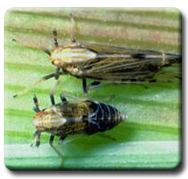 |
Identification of the pest
- Egg - Laid inside the leaf tissue and covered with a white waxy substance.
- Adult - Yellowish brown to dark brown with translucent wings.
|
Management
- Spray with 0.04% diazine (or) dimethoate 0.02%
- Application of phosphomidon @ 250 ml in 450-500 litres water/ha.
|
|
| 6. Earhead bug: Calocoris angustatus |
Symptom of damage
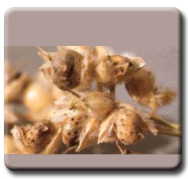
- Nymphs and adult suck the juice from within the grains when they are in the milky stage.
- Grains shrink and turn black in colour and ill filled (or) chaffy.
- Presence of large number of nymphs and adults are seen on the ear head.
|
 |
Identification of the pest
- Egg - Blue cigar shaped , laid under the glumes or into the middle of the florets
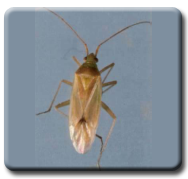
- Nymphs - Slender, green in colour
- Adults - Male is green in colour. Female is green with a brown margin
|
|
|
Management
- ETL: 10 / earhead
- Apply any one of the following on 3rd and 18th day after
panicle emergence :
- Carbaryl 10 D 25 kg/ha
- Malathion 5 D 25 kg/ha
- Neem seed kernel extract 5%
- Spray twice with Malathion 50 EC 500 ml/ha. in 500 lit of water at
10% heading and 9days after.
|
| III. Sap feeders |
Top
|
| 7. Sorghum midge: Contarinia sorghicola |
Symptoms of damage
- Pollen shedding due to egg laying
- White pupal cases protruding out from the grains
- Chaffy grains with holes
Identification of the pest
- Adult - Fly is small, fragile with a bright orange abdomen and a pair of transparent wings.
|
Management
- Sett up of light traps till mid night to monitor, attract and kill adults
of stem borer, grain midge and earhead caterpillars.
- Apply any one of the following on 3rd and 18th day after
panicle emergence :
- Carbaryl 10 D 25 kg/ha
- Malathion 5 D 25 kg/ha
- Phosalone 4 D 25 kg/ha
- Neem seed kernel extract 5% (or) Spray malathion 50 EC @ 1600 ml/ha or phosalone 1150 ml/ha
- The sowing of sorghum should be completed in as short a time
as possible to avoid continuous flowering which favours grain
midge and earhead bug multiplication in an area.
|
Top
|
| 8.Plant lice: Rhopalosiphum maidis |
Symptoms of damage
- Yellowing of leaves
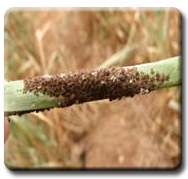
- Colonies of aphids found in central leaf whorl.
|
 |
Identification of the pest
- Yellow with dark green legs
Management
- Spraying the base of attacked plants with a contact (or) systemic insecticide controls the aphid.
|
|
|